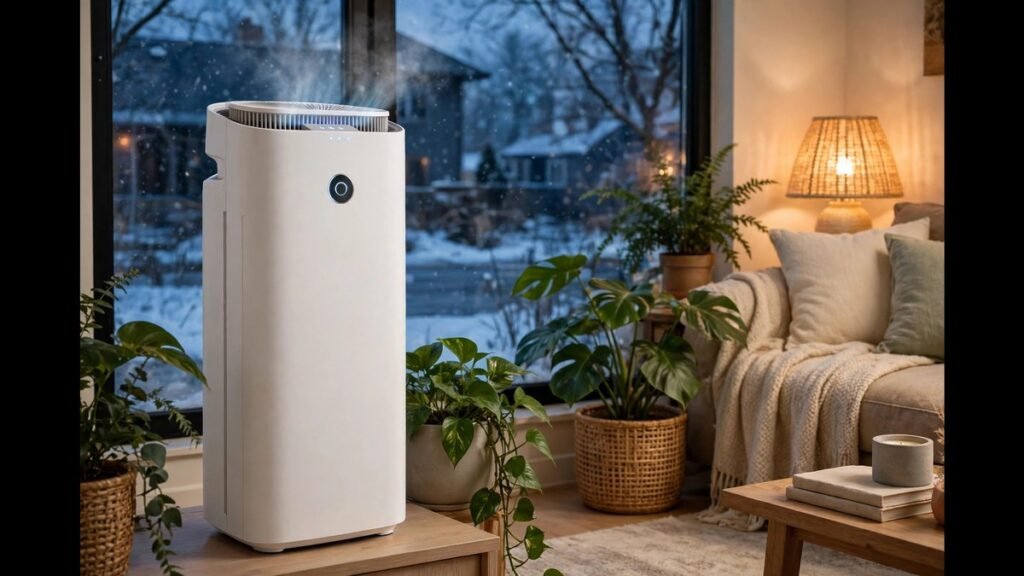
Winter is when indoor air gets at its worst in most American homes. The windows stay shut for months, the heat runs around the clock, and everything that would normally drift outside — dust, pet hair, cooking smells, fireplace smoke — just keeps circulating in the same closed rooms. It is no surprise that a lot of people start shopping for an air purifier right about now. The problem is that the boxes all promise the same thing, and the numbers on them do not mean what most buyers think they mean. Here is how to pick one that actually fits your home.
Start with the room, not the purifier
The single most important number on any air purifier is the room size it is rated to clean, usually listed as a square footage or a CADR (Clean Air Delivery Rate) number. A purifier rated for 200 square feet will run all day in a 400-square-foot living room and barely make a dent.
Measure the room where the purifier will actually live, then match it. If you are between sizes, go up one step rather than down — a slightly oversized purifier can run on its quiet low setting and still clean the air, while an undersized one has to scream on high to keep up. Bedrooms matter most, because you spend seven or eight hours breathing that air with the door closed.
One thing to watch: some brands list a room size based on one air change per hour, others on four or five. That is why two purifiers with the same CADR can claim wildly different room sizes. CADR is the steadier number to compare — look for a smoke CADR at least two-thirds of the room’s square footage.
Filters: what actually does the work
Almost every good purifier today uses the same basic setup: a pre-filter that catches hair and big dust, a HEPA filter that catches the fine stuff, and usually an activated carbon filter that soaks up smells and cooking fumes.
The words on the box deserve a second look. “True HEPA” means the filter meets the standard of catching 99.97% of particles at 0.3 microns. “HEPA-type” or “HEPA-like” is a weaker claim — those filters catch less, and the difference shows up when wildfire smoke or heavy pollen is in the air. If anyone in the house has allergies or asthma, true HEPA is worth insisting on.
The carbon filter matters more than most people expect in winter, when cooking smells and fireplace smoke linger. But carbon filters wear out faster than HEPA filters — often in three to six months with heavy use — so check the replacement cost before you buy. A purifier that costs $80 but needs $40 filters every three months is a $240-a-year machine.
A note on extras: ionizers and UV lights sound impressive on the box, but for most homes they add little on top of a good HEPA filter, and some ionizers produce small amounts of ozone, which is the opposite of what you want in a bedroom. A plain HEPA-plus-carbon purifier from a known brand is the safe choice.
Noise: the spec people regret ignoring
An air purifier runs for hours at a time, often while you sleep, so noise is not a minor detail. On high, most purifiers sound like a small fan on full blast — fine during the day, miserable at night. On low or sleep mode, a good one drops to a soft hum you can sleep through.
Auto mode is worth having: a sensor reads the air quality and speeds the fan up when you start cooking or when the dog shakes off, then quiets down again on its own. A simple air-quality indicator light — green, yellow, red — is genuinely useful, because it tells you at a glance whether the room actually needs the purifier running hard.
Who an air purifier is NOT for
An air purifier cleans the air. It does not add moisture, it does not heat or cool a room, and it does not fix the source of a problem. If your house smells musty because of a damp basement or a leak, a purifier will mask the smell for a while and the damp will keep coming back. Fix the leak first.
It is also not a substitute for ventilation. A purifier recirculates the same air through a filter; it does not bring in fresh air. Cracking a window for ten minutes on a mild winter afternoon does something no filter can. And if your main complaint is dry air — scratchy throat, static shocks, dry skin — you want a humidifier, not a purifier. Our humidifier guide walks through how to pick one that actually helps in winter.
A small purifier is also a poor buy for an open-plan home. If your living room, dining room and kitchen are one big space, a single tabletop unit will not cover it — you either need a large unit rated for the whole space, or two smaller ones at opposite ends.
Common mistakes to avoid
The first is buying too small. People shop by price, pick the cheapest unit, and then wonder why the air in the living room never seems better. Match the CADR to the room and the problem mostly disappears.
The second is hiding the purifier. It needs clear space around it — at least a foot from the wall — so air can flow in and out. Tucked behind a sofa or crammed into a corner, it cleans the air behind the sofa and not much else.
The third is forgetting the filter. The reminder light is easy to ignore for a month or two, but a clogged filter does not just clean less — it makes the fan work harder, gets louder, and can start smelling stale. Set a phone reminder for the replacement date the day the purifier arrives.
Finally, do not leave it off all day and expect a miracle at night. A purifier works best running steadily on low or auto, keeping the room clean around the clock, rather than blasting for an hour before bed and sitting idle the rest of the day. Keeping the house sealed and warm helps too — our guide on keeping your home warm without cranking the heat covers the draft and insulation side of winter comfort.
FAQ
How long does it take for an air purifier to clean a room?
For a correctly sized unit, most rooms show a real improvement within 30 to 60 minutes on a medium or high setting. After that, running it steadily on low or auto keeps it clean.
Do air purifiers help with allergies?
Yes, for airborne triggers like pollen, dust mites and pet dander — a true HEPA filter catches those particles. They do not help with allergies triggered by food or contact.
Can I run an air purifier all day?
Yes. That is how they are designed to work. Running on low or auto all day costs little in electricity and keeps the room consistently clean.
Where should I put an air purifier in a bedroom?
Near where you sleep, with clear space around it and the air outlet pointed toward the bed rather than at a wall. Keep the door closed at night so it is cleaning one room, not the whole house.
🛒 Shop This Guide – Buy on Amazon
As an Amazon Associate, Trend Trolley earns from qualifying purchases. The products below are ones we recommend in this guide — prices and availability can change, so check the current price on Amazon before you order. Buying through these links supports Trend Trolley at no extra cost to you.

Kasa Smart Plug HS103P2 (2-Pack) by TP-Link
Plug your purifier into a smart plug and set it to run on a schedule, or switch it on from your phone before you get home so the bedroom air is already clean.

Pair it with a smart plug and you can run the purifier with a voice command or an Alexa routine, like switching it on when you start cooking.
As an Amazon Associate, Trend Trolley earns from qualifying purchases.