🛒 Shop This Guide – Buy on Amazon
Affiliate Disclosure: Trend Trolley is a participant in the Amazon Services LLC Associates Program. If you buy through a link on this page, we may earn a small commission at no extra cost to you. Prices and availability change often, so please check the current price on Amazon before you buy.
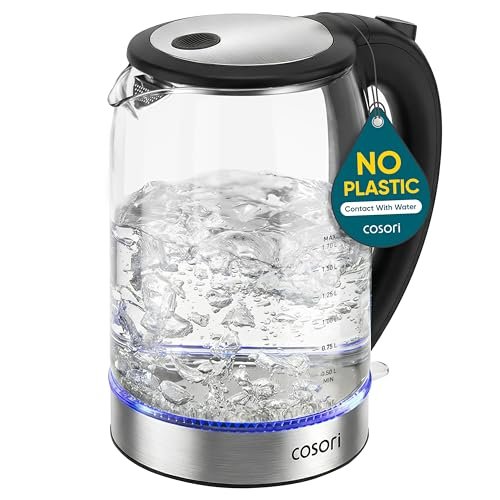
COSORI Electric Kettle 1.7L Glass (Black) – Buy on Amazon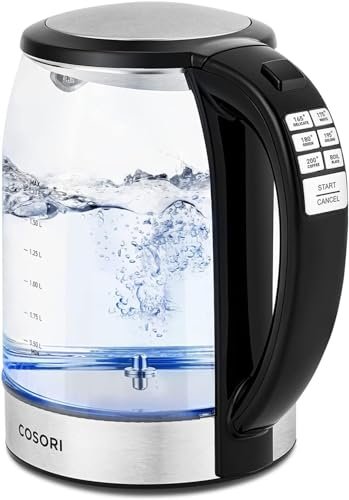
COSORI Electric Kettle with Temperature Control – Buy on Amazon
As an Amazon Associate, Trend Trolley earns from qualifying purchases.
Electric kettles are fast, efficient and popular in US homes for tea, coffee and cooking. This guide explains how to choose size, speed and safety features, including US voltage, capacity, auto shut-off, materials and temperature control. Prices are typical ranges in USD for product types.
US voltage and wattage
US homes use 120-volt outlets. Most electric kettles for the US market are designed for that voltage and draw about 1,000 to 1,500 watts. Higher wattage usually means faster boiling, but it also draws more power at once. Check that the kettle is rated for US use and has a standard US plug. Do not use travel adapters or converters for everyday kettle use. Plug the kettle directly into a wall outlet, not a power strip, unless the manufacturer allows it.
Capacity
Capacity is measured in liters or cups. A 1-liter kettle suits one or two people. A 1.7-liter kettle suits families or frequent use. Larger kettles take more counter space and use more energy to boil a full pot, so boil only what you need. Check the minimum fill line as well as the maximum. Some kettles have a small minimum, which is helpful for a single cup.
Pros and cons
- Electric kettles: pros are speed, auto shut-off and no stove needed; cons are counter space and the need to descale.
- Stovetop kettles: pros are no cord and simple design; cons are slower heating and no auto shut-off.
Auto shut-off and safety features
Look for auto shut-off when water boils, boil-dry protection, a cool-touch handle and a secure lid. A 360-degree base makes it easier to place the kettle back. Cordless bases are convenient, but keep the cord tidy and away from heat. Check whether the spout has a filter to catch scale. Safety features matter more than extra gadgets. Never open the lid while water is boiling, and keep the kettle out of reach of children.
Materials
Electric kettles come in stainless steel, glass and plastic. Stainless steel is durable and keeps heat well. Glass lets you see the water level but can break if dropped. Plastic is light and often cheaper, but check that it is BPA-free if that matters to you. The heating plate is usually hidden under a metal plate for easier cleaning. Choose a material that fits your kitchen style and cleaning habits.
Temperature control for tea and coffee
Different teas and coffees taste best at different temperatures. Basic kettles boil to 212 degrees Fahrenheit. Temperature-control kettles let you choose settings such as 160, 175, 185, 195 or 212 degrees. This is useful for green tea, white tea, oolong and pour-over coffee. Temperature control adds cost, often about $10 to $25 more, but it can improve flavor. If you only drink black tea or instant coffee, a basic kettle may be enough.
Speed
Speed depends on wattage and the amount of water. A 1,500-watt kettle boils a liter faster than a 1,000-watt kettle. Speed is helpful in busy mornings, but do not fill the kettle to the top every time. Boiling less water saves time and energy. Check reviews for noise level as well, because some kettles are louder than others.
Cleaning and descaling
Descale your kettle every few months, more often if you have hard water. Use a vinegar and water solution or a descaling product made for kettles, following the directions. Wipe the exterior with a damp cloth and never submerge the base in water. Clean the spout filter regularly. A clean kettle heats faster and tastes better.
Frequently asked questions
What size electric kettle do I need?
For one or two people, 1 liter is enough. For families, choose 1.5 to 1.7 liters. Boil only what you need to save energy.
Do I need temperature control?
Only if you drink teas or coffees that benefit from specific temperatures. A basic kettle is fine for boiling water for black tea or cooking.
Is auto shut-off important?
Yes. Auto shut-off and boil-dry protection are key safety features. Look for them on every electric kettle you consider.
Can I plug an electric kettle into a power strip?
Usually no. Plug it directly into a wall outlet unless the manufacturer specifically allows a power strip.
Conclusion
Choosing an electric kettle for a US home comes down to size, speed, safety features, materials and temperature control. Check US voltage, pick a capacity that fits your household, and prioritize auto shut-off and boil-dry protection. With typical prices in USD, a good kettle can make tea, coffee and cooking faster and safer every day.
Price ranges help you compare kettles without getting lost in brand names. Basic electric kettles often cost about $15 to $25, mid-range stainless steel kettles about $25 to $40, and temperature-control kettles about $35 to $60. Gooseneck kettles for pour-over coffee can cost more. Higher price does not always mean faster boiling; check wattage, capacity and safety features instead. Look for a kettle with a clear water window, a comfortable handle and a base that is stable on your counter. Measure your counter space and cabinet height before buying, because some kettles are tall.
Think about how you will use the kettle each day. If you make one cup of tea in the morning, a small kettle with a low minimum fill line is ideal. If you cook pasta or make coffee for a family, a larger kettle saves time. If you pour over coffee, a gooseneck spout gives more control. If you mainly boil water for cooking, speed and capacity matter most. Choose the kettle that matches your routine, not the one with the most features you will never use.
Finally, check the cord and storage. A short cord is safer but may not reach your outlet. A cord wrap on the base helps keep the counter tidy. Store the kettle on its base when not in use, and let it cool before moving it. Descale regularly and replace the kettle if the cord or base is damaged. With the right size, speed and safety features, an electric kettle can become one of the most used gadgets in your US kitchen.