There’s a specific kind of panic that only happens at an airport in December. Your flight is delayed, the gate changed twice, your phone is at 8%, and every outlet in the terminal already has someone’s laptop plugged into it. I learned this lesson the hard way a few years ago, standing in a crowded terminal with a dead phone and a boarding pass I couldn’t pull up.
Holiday travel is the hardest test a power bank will ever face. Long flights, road trips through areas with spotty service, cold weather that drains batteries faster, and days where your phone is your map, your ticket, your camera, and your entertainment all at once. The right charger makes all of that boring. The wrong one dies halfway through the trip.
What “capacity” actually means when you’re traveling
Power banks are sold by a number — 10,000 mAh is the most common — and it’s tempting to just buy the biggest number you can afford. But the number on the box isn’t the number your phone gets. Some energy is always lost as heat during charging, so a 10,000 mAh bank usually delivers around 6,000 to 7,000 mAh of real charging. That’s still enough for about two full charges of most modern phones, which covers a long travel day.
For a single day of flights and waiting around, 10,000 mAh is the sweet spot. It’s small enough to fit in a jacket pocket and light enough that you forget it’s there. If you’re traveling with a family, or you’re the person everyone asks to charge their phone, step up to 20,000 mAh — but know that it will be heavier and take longer to recharge overnight.
There’s one rule that matters more than any number: airlines limit power banks in checked luggage, and most won’t allow anything over 100 watt-hours in a carry-on without approval. A 10,000 mAh bank is well under that limit. Keep your power bank in your carry-on or personal item, never in a checked bag.
Charging speed matters more than you think
Here’s the part most people skip when they buy a power bank: how fast it charges your phone. A slow bank will take two hours to top up your phone. A fast one can do the same job in under an hour, and during a 45-minute layover, that difference is everything.
Look for a bank that supports fast charging through USB-C — it’s the standard most phones use now, and it’s noticeably quicker than the old USB-A ports. The cable matters too. A cheap, thin cable can bottleneck the whole setup, so use the cable that came with your phone.
And don’t forget to charge the bank itself before you leave. A power bank charges much slower than a phone — a 10,000 mAh bank can take four or five hours to fill up from empty. Plug it in the night before your trip.
Size and weight: the trade-off nobody mentions
A power bank is only useful if you actually carry it. The big ones with huge capacity are great on paper and terrible in a coat pocket. They weigh down a small bag and take up space, and after an hour of walking through an airport you’ll wish you’d bought the smaller one.
Think about how you’ll carry it. If it lives in a backpack or a carry-on, size barely matters — go bigger. If it needs to fit in a jacket pocket or a small purse, stick to the slim 10,000 mAh size.
What else to pack with it
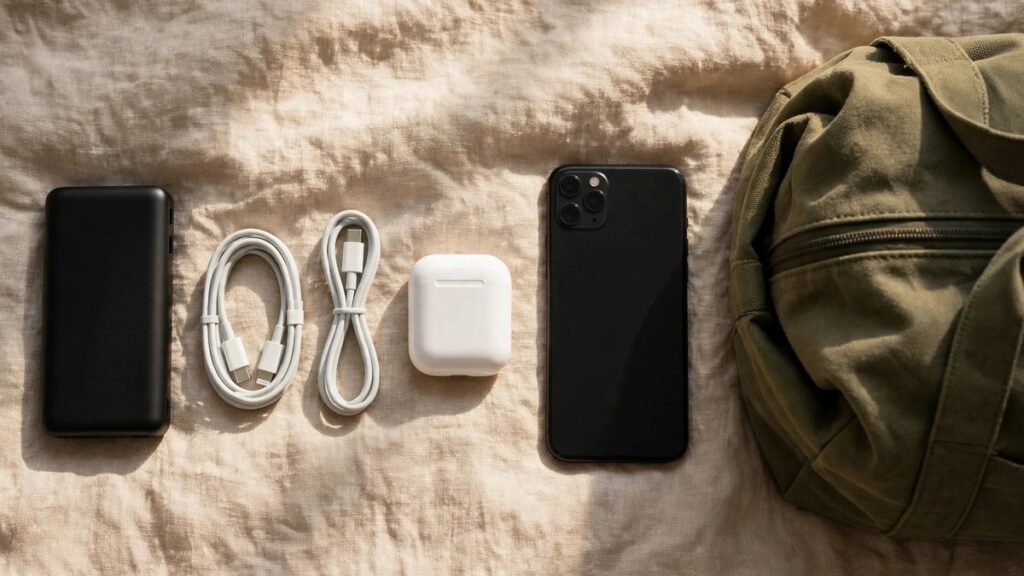
A power bank on its own only solves half the problem. The other half is everything around it. Our holiday travel tech kit covers the full packing list, but the short version is this: one good USB-C cable, one short backup cable, and a wall charger for the hotel room so you can recharge the bank overnight.
If you’re driving, a car charger or a small USB hub turns the car into a charging station for everyone. A hub with a few ports means the kids’ tablets, your phone, and your partner’s phone can all charge at once on a long drive, instead of taking turns.
For flights, a pair of wireless earbuds is the other must-pack. They turn a noisy cabin into something bearable and they’re small enough to live in the same pocket as your power bank. Good earbuds don’t need to cost a lot, but they do need to hold a charge through a flight.
And if you’re the family photographer, throw in a memory card or a small flash drive. Holiday trips fill up phone storage fast. A little extra storage means you don’t have to delete photos at the airport to make room for more.
Common mistakes that kill a power bank’s usefulness
The first mistake is buying a bank and never testing it before the trip. Charge it fully, plug in your phone, and make sure it actually charges at a decent speed. If it barely moves the battery percentage, you’ll find out at home instead of at gate B12.
The second is forgetting the cable. A power bank without the right cable is just a heavy rectangle. Keep the cable with the bank — in the same pocket, the same pouch, the same bag.
The third is leaving the bank in a hot car or a cold trunk. Extreme temperatures are bad for batteries, and a bank left in a freezing car overnight won’t perform well the next morning. Keep it in your bag, at roughly the same temperature you’d keep your phone.
Finally, don’t assume the airport will have free outlets. Some do, many don’t, and the ones that exist are usually taken. Plan as if the outlets don’t exist, and if you find one, it’s a bonus.
Frequently asked questions
Can I take a power bank on a plane in the USA?
Yes — in your carry-on or personal item, not in checked luggage. Most airlines allow power banks up to 100 watt-hours without special approval, which covers the common 10,000 and 20,000 mAh sizes.
How many times will a 10,000 mAh power bank charge my phone?
Usually about one and a half to two full charges for a modern smartphone, after accounting for energy lost as heat. That’s enough for a long travel day.
Why does my power bank charge my phone so slowly?
It’s usually the cable or the port. Use a USB-C port and a good-quality cable if your phone supports fast charging. Old USB-A cables and cheap cables can slow things down a lot.
Is it safe to leave a power bank charging overnight?
Yes, for a quality bank from a reputable brand — they have built-in protection against overcharging. Still, charge it on a hard surface rather than under a pillow or blanket, and replace it if it ever swells or gets very hot.
If you’re building out the rest of your travel kit on a budget, our best tech gadgets under $30 guide has a few more useful picks. Pack the bank the night before, charge it fully, and your phone will still be alive when the flight finally boards.
🛒 Shop This Guide – Buy on Amazon
Affiliate Disclosure: Trend Trolley is a participant in the Amazon Services LLC Associates Program. If you buy through a link on this page, we may earn a small commission at no extra cost to you. Prices and availability change often, so please check the current price on Amazon before you buy.
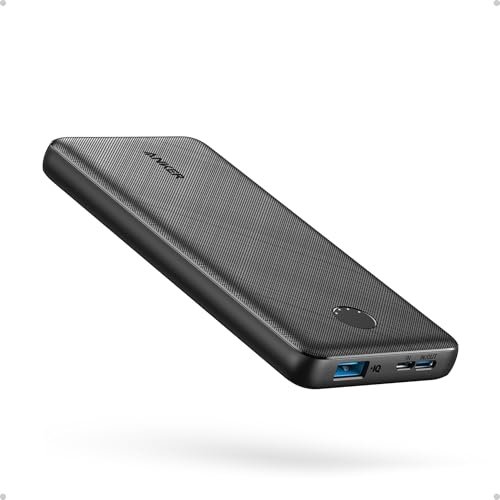
Anker PowerCore 10K Power Bank (A1229) – Buy on Amazon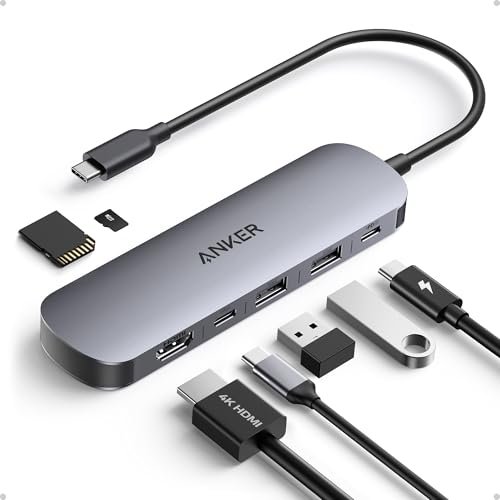
Anker USB C Hub 7-in-1 (A83D2) – Buy on Amazon
SanDisk Ultra 64GB microSDXC – Buy on Amazon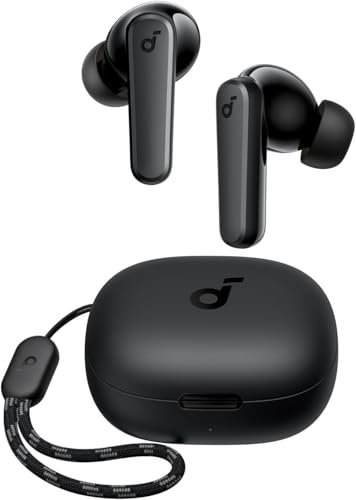
Soundcore by Anker P20i Earbuds (Black) – Buy on Amazon
As an Amazon Associate, Trend Trolley earns from qualifying purchases.